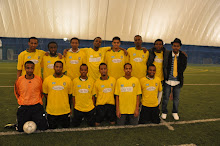
Missing Somalis investigation leads to 14 people charged
The Associated Press • November 24, 2009
Comments(188)
MINNEAPOLIS — Federal prosecutors unsealed new terrorism-related charges against eight people Monday as part of the long-running investigation of young men who left the United States to fight in Somalia.
As many as 20 young Somali men have left Minnesota in the past two years and are believed to have joined the Somali terrorist group al-Shabab. At least three have died.
The charges announced Monday include accusations that the men provided financial support to those who traveled to the East Africa country to fight on behalf of al-Shabab and also fought on behalf of the group, which the U.S. has designated a terrorist organization.
Court records indicate that between September 2007 and October 2009, about 20 young men left Minnesota for Somalia, where they are accused of training with al-Shabab to fight against Ethiopian forces. Prosecutors claim that while in Somalia, the young men were trained to use military weapons, including rocket-propelled grenades, and tactics.
A total of 14 people — including the eight announced Monday — have been charged in the investigation. Four have pleaded guilty and are awaiting sentencing. Seven are not in custody and are believed to be outside the United States.
FBI Director Robert Mueller has said the case is worrisome because it shows young men raised in the United States can be recruited by terrorists overseas, trained to conduct attacks and in some cases killed in the fighting there.
“The sad reality is that the vibrant Somali community here in Minneapolis has lost many of its sons to fighting in Somalia,” U.S. Attorney for Minnesota B. Todd Jones said in a statement.
One of the eight named Monday was Mohamud Said Omar, who was arrested earlier this month in the Netherlands. In the charges unsealed Monday, prosecutors accuse Omar, a Somali citizen and U.S. permanent resident, of helping young men travel from Minneapolis to Somalia and providing hundreds of dollars to fund the purchase of AK-47 rifles for the men.
Two of Omar’s brothers who live in Minnesota have said they believe their sibling is innocent, was not an extremist and was so poor that he couldn’t afford to bring his new wife from Somalia to the U.S.
Somalia has not had a functioning government since 1991, when warlords overthrew a socialist dictator and then turned on each other, causing chaos in the African nation of 7 million.
Sunday, November 29, 2009


Thursday, November 19, 2009
Web-based program aids translation at Melrose, Long Prairie clinics
Web-based program aids translation at Melrose, Long Prairie clinics
By Frank Lee • fclee@stcloudtimes.com • November 19, 2009
Comments(0)RecommendPrint this page E-mail this article Share
Del.icio.us Facebook Digg Reddit Newsvine Buzz up!
Twitter Health care reform is a complicated issue, but providing health care to people whose native language is not English just got a little easier.
CentraCare recently announced the use of a Web-based program at its Melrose and Long Prairie clinics “to provide linguistically and culturally competent care” to patients with limited English.
“We have significant Spanish-speaking populations in both Melrose and Long Prairie,” said Toni Tebben, site coordinator at CentraCare Clinic-Long Prairie.
The software application ProLingua helps the clinics’ staff to speak directly to patients in their primary language, from admission to discharge.
“ProLingua allows each member of our staff to focus on the care provided, rather than communication concerns,” said Julia Draxten, site coordinator at CentraCare Clinic-Melrose.
The software displays questions the health care provider wants to ask in English and in the patient’s native language on a monitor. It also uses pictures to help bridge the cultural gap.
“The way it’s designed is that it asks a series of questions in a way to get at essential information that we need, such as name, date of birth — basic information that we take for granted,” she said.
ProLingua currently supports Spanish, Vietnamese, Mandarin, Russian and Korean, with Somali, Arabic and Haitian-Creole in development.
“We’ve always used telephone interpretation services as well as in-person interpretation services, and we have a lot of our documents already translated into other languages, but what ProLingua does is allow us to have a lot of the information at our fingertips,” she said.
ProLingua also will say aloud the question that is being asked of the patient in the patient’s native language, according to Draxten.
“We can also print and send home patient instructions in, say, Spanish, so if they were there for an ear infection, we can tell them how to care for themselves in their own language,” she said.
Basic information such as the correct spelling of a patient’s name is important in order to look up a patient’s medical history if the patient has been previously seen at CentraCare.
“... We are committed to providing the highest quality of care to all patients, regardless of the language they speak,” Draxten said.
By Frank Lee • fclee@stcloudtimes.com • November 19, 2009
Comments(0)RecommendPrint this page E-mail this article Share
Del.icio.us Facebook Digg Reddit Newsvine Buzz up!
Twitter Health care reform is a complicated issue, but providing health care to people whose native language is not English just got a little easier.
CentraCare recently announced the use of a Web-based program at its Melrose and Long Prairie clinics “to provide linguistically and culturally competent care” to patients with limited English.
“We have significant Spanish-speaking populations in both Melrose and Long Prairie,” said Toni Tebben, site coordinator at CentraCare Clinic-Long Prairie.
The software application ProLingua helps the clinics’ staff to speak directly to patients in their primary language, from admission to discharge.
“ProLingua allows each member of our staff to focus on the care provided, rather than communication concerns,” said Julia Draxten, site coordinator at CentraCare Clinic-Melrose.
The software displays questions the health care provider wants to ask in English and in the patient’s native language on a monitor. It also uses pictures to help bridge the cultural gap.
“The way it’s designed is that it asks a series of questions in a way to get at essential information that we need, such as name, date of birth — basic information that we take for granted,” she said.
ProLingua currently supports Spanish, Vietnamese, Mandarin, Russian and Korean, with Somali, Arabic and Haitian-Creole in development.
“We’ve always used telephone interpretation services as well as in-person interpretation services, and we have a lot of our documents already translated into other languages, but what ProLingua does is allow us to have a lot of the information at our fingertips,” she said.
ProLingua also will say aloud the question that is being asked of the patient in the patient’s native language, according to Draxten.
“We can also print and send home patient instructions in, say, Spanish, so if they were there for an ear infection, we can tell them how to care for themselves in their own language,” she said.
Basic information such as the correct spelling of a patient’s name is important in order to look up a patient’s medical history if the patient has been previously seen at CentraCare.
“... We are committed to providing the highest quality of care to all patients, regardless of the language they speak,” Draxten said.
Wednesday, October 14, 2009
Organization brings community to African, African-American women

Organization brings community to African, African-American women
By TaLeiza Calloway • tcalloway@stcloudtimes.com • October 5, 2009
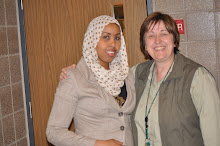
Launched in November, Omeka! aims to build relationships between African and African-American women in the St. Cloud community. The monthly gatherings offer food, fellowship, a listening heart and more. And the organization is looking ahead to its second year and the needs of its growing membership.
Debra Leigh, an Omeka! organizer and professor at St. Cloud State University, has seen growth among the women and the connections that have formed since the group’s founding.
Leigh remembers during an early circle-share-in, one Somali woman spoke for all of the Somali women in attendance. Ten months later, all those in attendance share what they are feeling, she said.
“It was really powerful,” Leigh said. “We realized that each of them had found their voice.”
“Omeka!” is a Swahili word meaning to display; to speak out; to spread out. This is accomplished each time through the sharing of journeys, cultures and ideas; they’re always learning from one another, according to organizers.
From education and health care, to family life and housing, each meeting has a theme. Women are not the only benefactors. Child care is always offered, complete with an activity for children.
Looking ahead
Possible changes ahead include focusing more meetings to a particular topic, hosting a two-day educational summit, creating a space just for the meetings as well as helping other diverse groups, Leigh said.
As organizers for Omeka! look ahead, they are confident the organization will continue to reach women and improve its outreach. They will meet in November for an overall evaluation of the program, said Hedy Tripp, coordinator for Create CommUNITY.
Omeka! is one of the programs under Create CommUNITY’s umbrella. It is funded through a grant from the Blue Cross Blue Shield Foundation.
“Omeka is an experiment,” Leigh said with a smile. “We learn as we go.”
Sister Chrispina Lekule, who worked with helping form Omeka! believes the mission is being fulfilled. Lekule is a graduate student at St. Cloud State.
Lefse: A Scandinavian tradition

Lefse: A Scandinavian tradition
By Amy Bowen • abowen@stcloudtimes.com • October 14, 2009
Read Comments(6) Recommend(5)Print this pageE-mail this articleShare
Del.icio.usFacebookDiggRedditNewsvineBuzz up!TwitterFOLEY — With the precision of a master baker, Mike Romslo ever so gently rolled out a paper-thin piece of lefse Tuesday night at Henry’s Banquet Center.
Romslo lives in International Falls, and drove down to visit his daughter Lisa Wruck, who lives in Foley. Wruck, asked him to help make lefse for the Gustavus Adolphus Lutheran Church’s annual fall dinner Oct. 21.
Romslo, who proudly claims he’s 100 percent Norwegian, happily made the trip, and joined about 12 volunteers who made 100 dozen lefse rounds Monday and Tuesday night.
Romslo knows lefse. He grew up on it. Christmas isn’t Christmas without lefse, he said.
His sentiment is shared by the other church members and family members who took part in the lefse-making project.
The Foley church’s dinner and bake sale, both offering homemade lefse, is the church’s only fundraiser, said Connie Henry, who served as one of the head lefse makers. The church has made the lefse for at least 35 years, she said.
For those who aren’t Scandinavian, lefse is like a potato crepe. Church lefse makers peeled potatoes, boiled and mashed them. They then added a little salt, white pepper and sugar and “lots of butter and whipping cream,” said fellow lefse maker and owner of Henry’s Banquet Center Sharon Henry. She is not related to Connie Henry.
“That’s Norwegian,” Sharon Henry said. “You need butter on everything.”
The dough is chilled until workers are ready to use an ice cream scoop to make balls.
That was Alvin Henry’s job Tuesday night. Connie Henry is his wife. He laughed and chatted with fellow bakers as he made the dough balls. The community really looks forward to the lefse, he said.
It doesn’t matter if they’re Scandinavian, he said with a chuckle.
“We spoil people,” he said.
Marilyn Hovde, one of the lefse rollers, has been spoiled for almost 40 years. She’s Dutch and Swedish. Her husband is 100 percent Norwegian, she said.
“I didn’t know what lefse was until I married (him), and now I love it,” she said as she rolled the dough balls into thin disks.
The lefse is then carefully transferred to a hot lefse pan and cooked until just browned and bubbly. Romslo carefully watched his lefse puff up ever so slightly before he removed it.
“You just get the feeling,” he said of knowing when to take it off the heat.
The lefse is then cooled under blue towels to keep it from drying out. Blue just happens to be one of the colors featured on the Norwegian flag.
After the lefse is cooled, workers packaged it in plastic bags for use later.
How people enjoy the finished lefse is up to them. Some like white sugar. Others swear by brown sugar. Everyone loves butter.
Romslo sprinkles brown sugar on his and rolls it up.
“And sometimes (I add) butter,” he said. “But I’m staying away from that.”
Friday, October 9, 2009
St. Cloud man is jailed after khat shipment
St. Cloud man is jailed after khat shipment
Times staff report • October 9, 2009
Read Comments(1)
. Cloud police arrested a 25-year-old St. Cloud man after intercepting a package that held 21 pounds of the drug khat, also known as graba.
Adil M. Ali was arrested Wednesday on suspicion of fifth-degree possession of a controlled substance with the intent to distribute. He was taken to Stearns County Jail.
Khat, a leaf that is chewed, is a legal stimulant in many countries, but it is illegal in the United States.
Investigators with the St. Cloud Drug Unit learned that a shipment of khat was headed to St. Cloud from Kenya on Oct. 1. Officers headed off the shipment and then determined Ali was the intended recipient, according to police.
Police are still investigating and expect to make more arrests
Times staff report • October 9, 2009
Read Comments(1)
. Cloud police arrested a 25-year-old St. Cloud man after intercepting a package that held 21 pounds of the drug khat, also known as graba.
Adil M. Ali was arrested Wednesday on suspicion of fifth-degree possession of a controlled substance with the intent to distribute. He was taken to Stearns County Jail.
Khat, a leaf that is chewed, is a legal stimulant in many countries, but it is illegal in the United States.
Investigators with the St. Cloud Drug Unit learned that a shipment of khat was headed to St. Cloud from Kenya on Oct. 1. Officers headed off the shipment and then determined Ali was the intended recipient, according to police.
Police are still investigating and expect to make more arrests
Letter: Those who hate city are welcome to leave it
Letter: Those who hate city are welcome to leave it
By Gene Mills • St. Cloud • October 8, 2009
Read Comments(118) Recommend(1)Print this pageE-mail this articleShare
Del.icio.usFacebookDiggRedditNewsvineBuzz up!TwitterI was prepared to offer my thoughts on the two folks who recently submitted a scathing letter in the Times denouncing my town as a racist community. (“Reports past, present prove racist attitudes,” Sept. 30.)
I knew my thoughts wouldn’t be published in the Times for obvious reasons. Instead, I’m proud to say we never hear my town called White Cloud anymore. Perhaps it’s because we now have several schools with a very high minority enrollment.
People who support that letter hate the town I’ve called home for nearly 50 years. My advice to those people: Don’t let the door hit you in the rear when you leave my town. Good riddance, friend. I hope you find a town where everyone thinks exactly the way you think.
It must be tough living with hate.
By Gene Mills • St. Cloud • October 8, 2009
Read Comments(118) Recommend(1)Print this pageE-mail this articleShare
Del.icio.usFacebookDiggRedditNewsvineBuzz up!TwitterI was prepared to offer my thoughts on the two folks who recently submitted a scathing letter in the Times denouncing my town as a racist community. (“Reports past, present prove racist attitudes,” Sept. 30.)
I knew my thoughts wouldn’t be published in the Times for obvious reasons. Instead, I’m proud to say we never hear my town called White Cloud anymore. Perhaps it’s because we now have several schools with a very high minority enrollment.
People who support that letter hate the town I’ve called home for nearly 50 years. My advice to those people: Don’t let the door hit you in the rear when you leave my town. Good riddance, friend. I hope you find a town where everyone thinks exactly the way you think.
It must be tough living with hate.
Letter: Reports past, present prove racist attitudes
Letter: Reports past, present prove racist attitudes
By Michael Davis • St. Cloud and • September 30, 2009
Read Comments(67) Recommend(3)Print this pageE-mail this articleShare
Del.icio.usFacebookDiggRedditNewsvineBuzz up!TwitterCompelling evidence indicates St. Cloud's historic and continuing racial problems demand:
A functioning and reliable human rights office with enforcement authority.
Constant investigation, intervention and monitoring from outside.
Dependable tools for discrimination redress.
And an aggressive NAACP, for once.
Despite denying, downplaying and/or ignoring facts of St. Cloud's "inglorious" or "sordid" racial history (as cited by Star Tribune columnist Doug Grow and described in letters to Twin Cities' high schools, 2002), cause-effect relationships establish relevance.
For anyone daring to investigate, available details of community racism shout from St. Cloud Times' archives, Stearns County Historical Museum documents and conclusions from a plethora of critical studies.
Claims of historical irrelevance presented in the Sept. 19 Your Turn "Critics offered limited solutions," by Mike Landy, conveniently dismiss the cumulative impact of illegal slaves, Bettye King's critical Saudia report and University of Minnesota Law School findings of up to 7-to-1 race-based profiling.
A letter from Landy to the Council on Black Minnesotans in 1998 stated, "If the Black Community wishes to move forward quickly it should seek the path of least resistance first before it chooses to be confrontational."
The "path of least resistance" appeases the status quo. At what point does a history of injustice become relevant enough to confront, defy and force change?
The Aspen Institute in 2008 selected St. Cloud among 42 communities nationwide to study race relations. Evidently, Aspen researchers recognize relevance in past and present patterns of racism.
St. Cloud had double the hate crimes of other Minnesota cities, according to 2006 FBI statistics, with few arrests. And we don't think history is relevant? Racism remains. ("City addresses hate;" St. Cloud Times, 11/24/07); "Hate group activity flourishes: Movement on rise again, report finds" St. Cloud Times, 12/21/07)
The effect is justice denied, thus relevance.
By Michael Davis • St. Cloud and • September 30, 2009
Read Comments(67) Recommend(3)Print this pageE-mail this articleShare
Del.icio.usFacebookDiggRedditNewsvineBuzz up!TwitterCompelling evidence indicates St. Cloud's historic and continuing racial problems demand:
A functioning and reliable human rights office with enforcement authority.
Constant investigation, intervention and monitoring from outside.
Dependable tools for discrimination redress.
And an aggressive NAACP, for once.
Despite denying, downplaying and/or ignoring facts of St. Cloud's "inglorious" or "sordid" racial history (as cited by Star Tribune columnist Doug Grow and described in letters to Twin Cities' high schools, 2002), cause-effect relationships establish relevance.
For anyone daring to investigate, available details of community racism shout from St. Cloud Times' archives, Stearns County Historical Museum documents and conclusions from a plethora of critical studies.
Claims of historical irrelevance presented in the Sept. 19 Your Turn "Critics offered limited solutions," by Mike Landy, conveniently dismiss the cumulative impact of illegal slaves, Bettye King's critical Saudia report and University of Minnesota Law School findings of up to 7-to-1 race-based profiling.
A letter from Landy to the Council on Black Minnesotans in 1998 stated, "If the Black Community wishes to move forward quickly it should seek the path of least resistance first before it chooses to be confrontational."
The "path of least resistance" appeases the status quo. At what point does a history of injustice become relevant enough to confront, defy and force change?
The Aspen Institute in 2008 selected St. Cloud among 42 communities nationwide to study race relations. Evidently, Aspen researchers recognize relevance in past and present patterns of racism.
St. Cloud had double the hate crimes of other Minnesota cities, according to 2006 FBI statistics, with few arrests. And we don't think history is relevant? Racism remains. ("City addresses hate;" St. Cloud Times, 11/24/07); "Hate group activity flourishes: Movement on rise again, report finds" St. Cloud Times, 12/21/07)
The effect is justice denied, thus relevance.
Tuesday, September 29, 2009
Your turn, human rights office debate: Critics offered limited solutions
Your turn, human rights office debate: Critics offered limited solutions
By Mike Landy • St. Cloud • September 19, 2009
Read Comments(17) RecommendPrint this pageE-mail this articleShare
Del.icio.usFacebookDiggRedditNewsvineBuzz up!TwitterAs a result of my participation in policymaking for 10 years in the city of St. Cloud, I feel compelled to address the two Your Turns published Sept. 12 focusing on the city’s human rights services.
One was “Department would help create community that is more inclusive” and the other was “We need to all work together.” The authors are associated with St. Cloud State University.
These articles expressed an abundance of negative sentiment about race relationships within our community, border on racism in and of themselves, and did little to demonstrate the need for a full-time human rights office as opposed to the city attorney and his staff functioning in that role.
The city is experiencing a funding crisis and efficiencies are necessary. The two articles limited their solution to a full-time human rights office and director.
Shouldn’t the most important justification be the result as opposed to the process and players along the way? I think it should. The commentaries missed the real issue as they never clearly shared their aspirations or end game, nor provided further alternatives.
During the past decade much has been done to educate the public about race and gender equality and law that prohibits discrimination. The city has been front and center and has accepted its responsibilities to do its part.
However, the city itself has not been the focal point on the educational front. Diversity education has primarily been carried out by numerous nonprofits and other groups. My hope is that all of this work will continue and be funded from nongovernmental sources as it should be. The sizable influx of Somali immigrants gives great cause to continue this work, not to mention the notion that the work is simply not complete.
The Your Turn “Department would help create community that is more inclusive” cites St. Cloud’s “sordid racial history.” It recounts the 1857 arrival of Mary Butler, a slave as an example. The 1857 example is not relevant in 2009 and does nothing to support a proposal for a stand-alone human rights office
Further, it cites two decade-old studies conducted by consultants Elsa Batica and Betty King to support the view that people of color do not feel welcome today in St. Cloud. The piece also cited a 2003 study to imply that today’s St. Cloud Police Department does racial profiling.
The other piece, “We all need to work together,” states St. Cloud must maintain a “full-time human rights office, with a full-time human rights director period.”
It would be unfair to suggest that there is no racism in the city. However, it would be just as unfair to discuss the racism issue without commenting about the hard work expended and improvements made by a number of entities and individuals. Honestly, both communities have come a great distance fully realizing we certainly need to travel on.
However, it is no service to the community for these two authors to suggest that reassigning the duties and responsibilities from the former human rights director to legal staff within the city attorney’s office equates to abandoning the cause. It does not. It solely demonstrates the continuation of an important priority more efficiently.
Tough economic circumstances are facing the mayor and the City Council, and I applaud their willingness to identify better and more efficient ways to serve us as city residents.
This is the opinion of St. Cloud resident Mike Landy.
By Mike Landy • St. Cloud • September 19, 2009
Read Comments(17) RecommendPrint this pageE-mail this articleShare
Del.icio.usFacebookDiggRedditNewsvineBuzz up!TwitterAs a result of my participation in policymaking for 10 years in the city of St. Cloud, I feel compelled to address the two Your Turns published Sept. 12 focusing on the city’s human rights services.
One was “Department would help create community that is more inclusive” and the other was “We need to all work together.” The authors are associated with St. Cloud State University.
These articles expressed an abundance of negative sentiment about race relationships within our community, border on racism in and of themselves, and did little to demonstrate the need for a full-time human rights office as opposed to the city attorney and his staff functioning in that role.
The city is experiencing a funding crisis and efficiencies are necessary. The two articles limited their solution to a full-time human rights office and director.
Shouldn’t the most important justification be the result as opposed to the process and players along the way? I think it should. The commentaries missed the real issue as they never clearly shared their aspirations or end game, nor provided further alternatives.
During the past decade much has been done to educate the public about race and gender equality and law that prohibits discrimination. The city has been front and center and has accepted its responsibilities to do its part.
However, the city itself has not been the focal point on the educational front. Diversity education has primarily been carried out by numerous nonprofits and other groups. My hope is that all of this work will continue and be funded from nongovernmental sources as it should be. The sizable influx of Somali immigrants gives great cause to continue this work, not to mention the notion that the work is simply not complete.
The Your Turn “Department would help create community that is more inclusive” cites St. Cloud’s “sordid racial history.” It recounts the 1857 arrival of Mary Butler, a slave as an example. The 1857 example is not relevant in 2009 and does nothing to support a proposal for a stand-alone human rights office
Further, it cites two decade-old studies conducted by consultants Elsa Batica and Betty King to support the view that people of color do not feel welcome today in St. Cloud. The piece also cited a 2003 study to imply that today’s St. Cloud Police Department does racial profiling.
The other piece, “We all need to work together,” states St. Cloud must maintain a “full-time human rights office, with a full-time human rights director period.”
It would be unfair to suggest that there is no racism in the city. However, it would be just as unfair to discuss the racism issue without commenting about the hard work expended and improvements made by a number of entities and individuals. Honestly, both communities have come a great distance fully realizing we certainly need to travel on.
However, it is no service to the community for these two authors to suggest that reassigning the duties and responsibilities from the former human rights director to legal staff within the city attorney’s office equates to abandoning the cause. It does not. It solely demonstrates the continuation of an important priority more efficiently.
Tough economic circumstances are facing the mayor and the City Council, and I applaud their willingness to identify better and more efficient ways to serve us as city residents.
This is the opinion of St. Cloud resident Mike Landy.
Create CommUNITY funds health worker

Create CommUNITY funds health worker
By Frank Lee • fclee@stcloudtimes.com • September 24, 2009
Read Comments(174) Recommend(5)Print this pageE-mail this articleShare
Del.icio.usFacebookDiggRedditNewsvineBuzz up!TwitterAt a time when access to health care in the United States has never been more hotly debated, Somalis living in Central Minnesota will continue to have one of their own to help them with it.
Create CommUNITY has awarded $20,000 to continue the Community Health Worker project in St. Cloud, which will allow Fartun Hussein, a Somali-American, to continue to serve as the community health worker for the Somali community in Central Minnesota until Jan. 15.
"It's a real critical need in that community, and we're hoping that it will be a model that we can replicate in other communities of color," said Hedy Tripp, Create CommUNITY coordinator.
Hussein has helped Somalis enroll in health care coverage, renew their existing coverage, schedule annual checkups and get prescriptions filled in the past year.
The Minnesota International Health Volunteers implemented the pilot project in June 2008, with one of the goals of the project being the education of health care professionals in the St. Cloud area about Somali culture, myths and beliefs about health.
Somali community
"We have a great health care system in Minnesota, but if your native language is not English, how do you navigate that? Even for people who speak English, sometimes it's difficult navigating the health care system," Tripp said.
Hussein received a bachelor's degree in community health from St. Cloud State University after moving from Kenya to Minnesota in 1999. She relocated to St. Cloud in 2001 and now works 32 hours a week with the Somali community.
During the past year, she visited 228 homes and served 105 households, surpassing the original project goal by 14 percent, according to Minnesota International Health Volunteers, a Minneapolis-based organization dedicated to improving the health of women and children worldwide.
"I think it's done more than what we even expected of it," said Tripp of Create CommUNITY, a St. Cloud-based initiative whose mission is to "dismantle racism through systemic change."
Helping others
Among her work of the past year, Hussein help a family new to St. Cloud connect with Stearns County Public Health to continue treatments for tuberculosis, and she educated a new mother who was positive for Hepatitis B on the importance of regular checkups and vaccination.
"Are communities of color able to navigate the health care system in the best way to benefit them?" Tripp said of the genesis of the project, which was the brainchild of Paul Knutson, chairman of the Create CommUNITY Healthcare Access Focus Area.
Hussein also conducted nine health forums in Somali on specific topics, most of which were requested. Topics included asthma, obesity, infectious diseases, back injuries, prenatal care, immunizations, autism, breast cancer and mental health.
"The rest of this year, we're going to look at the real evaluation on patient satisfaction, perhaps through some interviews and surveys with people in the community who have benefited from the Community Health Worker program," Tripp said.
Wednesday, September 16, 2009
See Baby Discriminate
See Baby Discriminate
Kids as young as 6 months judge others based on skin color. What's a parent to do?
By Po Bronson and Ashley Merryman | NEWSWEEK
Published Sep 5, 2009
From the magazine issue dated Sep 14, 2009
At the Children's Research Lab at the University of Texas, a database is kept on thousands of families in the Austin area who have volunteered to be available for scholarly research. In 2006 Birgitte Vittrup recruited from the database about a hundred families, all of whom were Caucasian with a child 5 to 7 years old.
The goal of Vittrup's study was to learn if typical children's videos with multicultural storylines have any beneficial effect on children's racial attitudes. Her first step was to give the children a Racial Attitude Measure, which asked such questions as:
How many White people are nice?
(Almost all) (A lot) (Some) (Not many) (None)
How many Black people are nice?
(Almost all) (A lot) (Some) (Not many) (None)
During the test, the descriptive adjective "nice" was replaced with more than 20 other adjectives, like "dishonest," "pretty," "curious," and "snobby."
Vittrup sent a third of the families home with multiculturally themed videos for a week, such as an episode of Sesame Street in which characters visit an African-American family's home, and an episode of Little Bill, where the entire neighborhood comes together to clean the local park.
In truth, Vittrup didn't expect that children's racial attitudes would change very much just from watching these videos. Prior research had shown that multicultural curricula in schools have far less impact than we intend them to—largely because the implicit message "We're all friends" is too vague for young children to understand that it refers to skin color.
Yet Vittrup figured explicit conversations with parents could change that. So a second group of families got the videos, and Vittrup told these parents to use them as the jumping-off point for a discussion about interracial friendship. She provided a checklist of points to make, echoing the shows' themes. "I really believed it was going to work," Vittrup recalls.
The last third were also given the checklist of topics, but no videos. These parents were to discuss racial equality on their own, every night for five nights.
At this point, something interesting happened. Five families in the last group abruptly quit the study. Two directly told Vittrup, "We don't want to have these conversations with our child. We don't want to point out skin color."
Vittrup was taken aback—these families volunteered knowing full well it was a study of children's racial attitudes. Yet once they were aware that the study required talking openly about race, they started dropping out.
It was no surprise that in a liberal city like Austin, every parent was a welcoming multiculturalist, embracing diversity. But according to Vittrup's entry surveys, hardly any of these white parents had ever talked to their children directly about race. They might have asserted vague principles—like "Everybody's equal" or "God made all of us" or "Under the skin, we're all the same"—but they'd almost never called attention to racial differences.
They wanted their children to grow up colorblind. But Vittrup's first test of the kids revealed they weren't colorblind at all. Asked how many white people are mean, these children commonly answered, "Almost none." Asked how many blacks are mean, many answered, "Some," or "A lot." Even kids who attended diverse schools answered the questions this way.
More disturbing, Vittrup also asked all the kids a very blunt question: "Do your parents like black people?" Fourteen percent said outright, "No, my parents don't like black people"; 38 percent of the kids answered, "I don't know." In this supposed race-free vacuum being created by parents, kids were left to improvise their own conclusions—many of which would be abhorrent to their parents.
Vittrup hoped the families she'd instructed to talk about race would follow through. After watching the videos, the families returned to the Children's Research Lab for retesting. To Vittrup's complete surprise, the three groups of children were statistically the same—none, as a group, had budged very much in their racial attitudes. At first glance, the study was a failure.
Combing through the parents' study diaries, Vittrup realized why. Diary after diary revealed that the parents barely mentioned the checklist items. Many just couldn't talk about race, and they quickly reverted to the vague "Everybody's equal" phrasing.
Of all those Vittrup told to talk openly about interracial friendship, only six families managed to actually do so. And, for all six, their children dramatically improved their racial attitudes in a single week. Talking about race was clearly key. Reflecting later about the study, Vittrup said, "A lot of parents came to me afterwards and admitted they just didn't know what to say to their kids, and they didn't want the wrong thing coming out of the mouth of their kids."
We all want our children to be unintimidated by differences and have the social skills necessary for a diverse world. The question is, do we make it worse, or do we make it better, by calling attention to race?
The election of President Barack Obama marked the beginning of a new era in race relations in the United States—but it didn't resolve the question as to what we should tell children about race. Many parents have explicitly pointed out Obama's brown skin to their young children, to reinforce the message that anyone can rise to become a leader, and anyone—regardless of skin color—can be a friend, be loved, and be admired.
Others think it's better to say nothing at all about the president's race or ethnicity—because saying something about it unavoidably teaches a child a racial construct. They worry that even a positive statement ("It's wonderful that a black person can be president") still encourages a child to see divisions within society. For the early formative years, at least, they believe we should let children know a time when skin color does not matter.
What parents say depends heavily on their own race: a 2007 study in the Journal of Marriage and Family found that out of 17,000 families with kindergartners, nonwhite parents are about three times more likely to discuss race than white parents; 75 percent of the latter never, or almost never, talk about race.
In our new book, NurtureShock, we argue that many modern strategies for nurturing children are backfiring—because key twists in the science have been overlooked. Small corrections in our thinking today could alter the character of society long term, one future citizen at a time. The way white families introduce the concept of race to their children is a prime example.
For decades, it was assumed that children see race only when society points it out to them. However, child-development researchers have increasingly begun to question that presumption. They argue that children see racial differences as much as they see the difference between pink and blue—but we tell kids that "pink" means for girls and "blue" is for boys. "White" and "black" are mysteries we leave them to figure out on their own.
It takes remarkably little for children to develop in-group preferences. Vittrup's mentor at the University of Texas, Rebecca Bigler, ran an experiment in three preschool classrooms, where 4- and 5-year-olds were lined up and given T shirts. Half the kids were randomly given blue T shirts, half red. The children wore the shirts for three weeks. During that time, the teachers never mentioned their colors and never grouped the kids by shirt color.
The kids didn't segregate in their behavior. They played with each other freely at recess. But when asked which color team was better to belong to, or which team might win a race, they chose their own color. They believed they were smarter than the other color. "The Reds never showed hatred for Blues," Bigler observed. "It was more like, 'Blues are fine, but not as good as us.' " When Reds were asked how many Reds were nice, they'd answer, "All of us." Asked how many Blues were nice, they'd answer, "Some." Some of the Blues were mean, and some were dumb—but not the Reds.
Bigler's experiment seems to show how children will use whatever you give them to create divisions—seeming to confirm that race becomes an issue only if we make it an issue. So why does Bigler think it's important to talk to children about race as early as the age of 3?
Her reasoning is that kids are developmentally prone to in-group favoritism; they're going to form these preferences on their own. Children naturally try to categorize everything, and the attribute they rely on is that which is the most clearly visible.
We might imagine we're creating color-blind environments for children, but differences in skin color or hair or weight are like differences in gender—they're plainly visible. Even if no teacher or parent mentions race, kids will use skin color on their own, the same way they use T-shirt colors. Bigler contends that children extend their shared appearances much further—believing that those who look similar to them enjoy the same things they do. Anything a child doesn't like thus belongs to those who look the least similar to him. The spontaneous tendency to assume your group shares characteristics—such as niceness, or smarts—is called essentialism.
Within the past decade or so, developmental psychologists have begun a handful of longitudinal studies to determine exactly when children develop bias. Phyllis Katz, then a professor at the University of Colorado, led one such study—following 100 black children and 100 white children for their first six years. She tested these children and their parents nine times during those six years, with the first test at 6 months old.
How do researchers test a 6-month-old? They show babies photographs of faces. Katz found that babies will stare significantly longer at photographs of faces that are a different race from their parents, indicating they find the face out of the ordinary. Race itself has no ethnic meaning per se—but children's brains are noticing skin-color differences and trying to understand their meaning.
When the kids turned 3, Katz showed them photographs of other children and asked them to choose whom they'd like to have as friends. Of the white children, 86 percent picked children of their own race. When the kids were 5 and 6, Katz gave these children a small deck of cards, with drawings of people on them. Katz told the children to sort the cards into two piles any way they wanted. Only 16 percent of the kids used gender to split the piles. But 68 percent of the kids used race to split the cards, without any prompting. In reporting her findings, Katz concluded: "I think it is fair to say that at no point in the study did the children exhibit the Rousseau type of color-blindness that many adults expect."
The point Katz emphasizes is that this period of our children's lives, when we imagine it's most important to not talk about race, is the very developmental period when children's minds are forming their first conclusions about race.
Several studies point to the possibility of developmental windows—stages when children's attitudes might be most amenable to change. In one experiment, children were put in cross-race study groups, and then were observed on the playground to see if the interracial classroom time led to interracial play at recess. The researchers found mixed study groups worked wonders with the first-grade children, but it made no difference with third graders. It's possible that by third grade, when parents usually recognize it's safe to start talking a little about race, the developmental window has already closed.
The other deeply held assumption modern parents have is what Ashley and I have come to call the Diverse Environment Theory. If you raise a child with a fair amount of exposure to people of other races and cultures, the environment becomes the message. Because both of us attended integrated schools in the 1970s—Ashley in San Diego and, in my case, Seattle—we had always accepted this theory's tenets: diversity breeds tolerance, and talking about race was, in and of itself, a diffuse kind of racism.
But my wife and I saw this differently in the years after our son, Luke, was born. When he was 4 months old, Luke began attending a preschool located in San Francisco's Fillmore/Western Addition neighborhood. One of the many benefits of the school was its great racial diversity. For years our son never once mentioned the color of anyone's skin. We never once mentioned skin color, either. We thought it was working perfectly.
Then came Martin Luther King Jr. Day at school, two months before his fifth birthday. Luke walked out of preschool that Friday before the weekend and started pointing at everyone, proudly announcing, "That guy comes from Africa. And she comes from Africa, too!" It was embarrassing how loudly he did this. "People with brown skin are from Africa," he'd repeat. He had not been taught the names for races—he had not heard the term "black" and he called us "people with pinkish-whitish skin." He named every kid in his schoolroom with brown skin, which was about half his class.
My son's eagerness was revealing. It was obvious this was something he'd been wondering about for a while. He was relieved to have been finally given the key. Skin color was a sign of ancestral roots.
Over the next year, we started to overhear one of his white friends talking about the color of their skin. They still didn't know what to call their skin, so they used the phrase "skin like ours." And this notion of ours versus theirs started to take on a meaning of its own. As these kids searched for their identities, skin color had become salient.
Soon, I overheard this particular white boy telling my son, "Parents don't like us to talk about our skin, so don't let them hear you."
As a parent, I dealt with these moments explicitly, telling my son it was wrong to choose anyone as his friend, or his "favorite," on the basis of skin color. We pointed out how certain friends wouldn't be in our lives if we picked friends for their color. Over time he not only accepted but embraced this lesson. Now he talks openly about equality and the wrongfulness of discrimination.
Not knowing then what I do now, I had a hard time understanding my son's initial impulses. Katz's work helped me to realize that Luke was never actually colorblind. He didn't talk about race in his first five years because our silence had unwittingly communicated that race was something he could not ask about.
The Diverse Environment Theory is the core principle behind school desegregation today. Like most people, I assumed that after 30 years of desegregation, it would have a long track record of scientific research proving that the Diverse Environment Theory works. Then Ashley and I began talking to the scholars who've compiled that very research.
In the summer of 2007, led by the Civil Rights Project, a dozen scholars wrote an amicus brief to the U.S. Supreme Court supporting school desegregation in Louisville, Ky., and Seattle. By the time the brief reached the court, 553 scientists had signed on in support. However, as much as the scientists all supported active desegregation, the brief is surprisingly circumspect in its advocacy: the benefits of desegregation are qualified with words like "may lead" and "can improve." "Mere school integration is not a panacea," the brief warns.
UT's Bigler was one of the scholars heavily involved in the process of its creation. Bigler is an adamant proponent of desegregation in schools on moral grounds. "It's an enormous step backward to increase social segregation," she says. However, she also admitted that "in the end, I was disappointed with the amount of evidence social psychology could muster [to support it]. Going to integrated schools gives you just as many chances to learn stereotypes as to unlearn them."
The unfortunate twist of diverse schools is that they don't necessarily lead to more cross-race relationships. Often it's the opposite. Duke University's James Moody—an expert on how adolescents form and maintain social networks—analyzed data on more than 90,000 teenagers at 112 different schools from every region of the country. The students had been asked to name their five best male friends and their five best female friends. Moody matched the ethnicity of the student with the race of each named friend, then compared the number of each student's cross-racial friendships with the school's overall diversity.
Moody found that the more diverse the school, the more the kids self-segregate by race and ethnicity within the school, and thus the likelihood that any two kids of different races have a friendship goes down.
Moody included statistical controls for activities, sports, academic tracking, and other school-structural conditions that tend to desegregate (or segregate) students within the school. The rule still holds true: more diversity translates into more division among students. Those increased opportunities to interact are also, effectively, increased opportunities to reject each other. And that is what's happening.
As a result, junior-high and high-school children in diverse schools experience two completely contrasting social cues on a daily basis. The first cue is inspiring—that many students have a friend of another race. The second cue is tragic—that far more kids just like to hang with their own. It's this second dynamic that becomes more and more visible as overall school diversity goes up. As a child circulates through school, she sees more groups that her race disqualifies her from, more lunchroom tables she can't sit at, and more implicit lines that are taboo to cross. This is unmissable even if she, personally, has friends of other races. "Even in multiracial schools, once young people leave the classroom, very little interracial discussion takes place because a desire to associate with one's own ethnic group often discourages interaction between groups," wrote Brendesha Tynes of the University of Illinois at Urbana-Champaign.
All told, the odds of a white high-schooler in America having a best friend of another race is only 8 percent. Those odds barely improve for the second-best friend, or the third-best, or the fifth. For blacks, the odds aren't much better: 85 percent of black kids' best friends are also black. Cross-race friends also tend to share a single activity, rather than multiple activities; as a result, these friendships are more likely to be lost over time, as children transition from middle school to high school.
I can't help but wonder—would the track record of desegregation be so mixed if parents reinforced it, rather than remaining silent? It is tempting to believe that because their generation is so diverse, today's children grow up knowing how to get along with people of every race. But numerous studies suggest that this is more of a fantasy than a fact.
Is it really so difficult to talk with children about race when they're very young? What jumped out at Phyllis Katz, in her study of 200 black and white children, was that parents are very comfortable talking to their children about gender, and they work very hard to counterprogram against boy-girl stereotypes. That ought to be our model for talking about race. The same way we remind our daughters, "Mommies can be doctors just like daddies," we ought to be telling all children that doctors can be any skin color. It's not complicated what to say. It's only a matter of how often we reinforce it.
Shushing children when they make an improper remark is an instinctive reflex, but often the wrong move. Prone to categorization, children's brains can't help but attempt to generalize rules from the examples they see. It's embarrassing when a child blurts out, "Only brown people can have breakfast at school," or "You can't play basketball; you're white, so you have to play baseball." But shushing them only sends the message that this topic is unspeakable, which makes race more loaded, and more intimidating.
To be effective, researchers have found, conversations about race have to be explicit, in unmistakable terms that children understand. A friend of mine repeatedly told her 5-year-old son, "Remember, everybody's equal." She thought she was getting the message across. Finally, after seven months of this, her boy asked, "Mommy, what's 'equal' mean?"
Bigler ran a study in which children read brief biographies of famous African-Americans. For instance, in a biography of Jackie Robinson, they read that he was the first African-American in the major leagues. But only half read about how he'd previously been relegated to the Negro Leagues, and how he suffered taunts from white fans. Those facts—in five brief sentences were omitted in the version given to the other children.
After the two-week history class, the children were surveyed on their racial attitudes. White children who got the full story about historical discrimination had significantly better attitudes toward blacks than those who got the neutered version. Explicitness works. "It also made them feel some guilt," Bigler adds. "It knocked down their glorified view of white people." They couldn't justify in-group superiority.
Minority parents are more likely to help their children develop a racial identity from a young age. April Harris-Britt, a clinical psychologist and professor at the University of North Carolina at Chapel Hill, found that all minority parents at some point tell their children that discrimination is out there, but they shouldn't let it stop them. Is this good for them? Harris-Britt found that some preparation for bias was beneficial, and it was necessary—94 percent of African-American eighth graders reported to Harris-Britt that they'd felt discriminated against in the prior three months.
But if children heard these preparation-for-bias warnings often (rather than just occasionally), they were significantly less likely to connect their successes to effort, and much more likely to blame their failures on their teachers—whom they saw as biased against them.
Harris-Britt warns that frequent predictions of future discrimination ironically become as destructive as experiences of actual discrimination: "If you overfocus on those types of events, you give the children the message that the world is going to be hostile—you're just not valued and that's just the way the world is."
Preparation for bias is not, however, the only way minorities talk to their children about race. The other broad category of conversation, in Harris-Britt's analysis, is ethnic pride. From a very young age, minority children are coached to be proud of their ethnic history. She found that this was exceedingly good for children's self-confidence; in one study, black children who'd heard messages of ethnic pride were more engaged in school and more likely to attribute their success to their effort and ability.
That leads to the question that everyone wonders but rarely dares to ask. If "black pride" is good for African-American children, where does that leave white children? It's horrifying to imagine kids being "proud to be white." Yet many scholars argue that's exactly what children's brains are already computing. Just as minority children are aware that they belong to an ethnic group with less status and wealth, most white children naturally decipher that they belong to the race that has more power, wealth, and control in society; this provides security, if not confidence. So a pride message would not just be abhorrent—it'd be redundant.
Over the course of our research, we heard many stories of how people—from parents to teachers—were struggling to talk about race with their children. For some, the conversations came up after a child had made an embarrassing comment in public. A number had the issue thrust on them, because of an interracial marriage or an international adoption. Still others were just introducing children into a diverse environment, wondering when and if the timing was right.
But the story that most affected us came from a small town in rural Ohio. Two first-grade teachers, Joy Bowman and Angela Johnson, had agreed to let a professor from Ohio State University, Jeane Copenhaver-Johnson, observe their classrooms for the year. Of the 33 children, about two thirds were white, while the others were black or of mixed-race descent.
It being December, the teachers had decided to read to their classes 'Twas the Night B'fore Christmas, Melodye Rosales's retelling of the Clement C. Moore classic. As the teachers began reading, the kids were excited by the book's depiction of a family waiting for Santa to come. A few children, however, quietly fidgeted. They seemed puzzled that this storybook was different: in this one, it was a black family all snug in their beds.
Then there was the famed clatter on the roof. The children leaned in to get their first view of Santa and the sleigh as Johnson turned the page—
And they saw that Santa was black.
"He's black!" gasped a white little girl.
A white boy exclaimed, "I thought he was white!"
Immediately, the children began to chatter about the stunning development. At the ripe old ages of 6 and 7, the children had no doubt that there was a Real Santa. Of that they were absolutely sure. But suddenly there was this huge question mark. Could Santa be black? And if so, what did that mean?
While some of the black children were delighted with the idea that Santa could be black, others were unsure. A couple of the white children rejected this idea out of hand: a black Santa couldn't be real.
But even the little girl the most adamant that the Real Santa must be white came around to accept the possibility that a black Santa could fill in for White Santa if he was hurt. And she still gleefully yelled along with the Black Santa's final "Merry Christmas to All! Y'all Sleep Tight."
Other children offered the idea that perhaps Santa was "mixed with black and white"—something in the middle, like an Indian. One boy went with a two-Santa hypothesis: White Santa and Black Santa must be friends who take turns visiting children. When a teacher made the apparently huge mistake of saying that she'd never seen Santa, the children all quickly corrected her: everyone had seen Santa at the mall. Not that that clarified the situation any.
The debate raged for a week, in anticipation of a school party. The kids all knew Real Santa was the guest of honor.
Then Santa arrived at the party—and he was black. Just like in the picture book.
Some white children said that this black Santa was too thin: that meant that the Real Santa was the fat white one at Kmart. But one of the white girls retorted that she had met the man and was convinced. Santa was brown.
Most of the black children were exultant, since this proved that Santa was black. But one of them, Brent, still doubted—even though he really wanted a black Santa to be true. So he bravely confronted Santa.
"There ain't no black Santas!" Brent insisted.
"Lookit here." Santa pulled up a pant leg.
A thrilled Brent was sold. "This is a black Santa!" he yelled. "He's got black skin and his black boots are like the white Santa's boots."
A black-Santa storybook wasn't enough to crush every stereotype. When Johnson later asked the kids to draw Santa, even the black kids who were excited about a black Santa still depicted him with skin as snowy white as his beard.
But the shock of the Santa storybook was the catalyst for the first graders to have a yearlong dialogue about race issues. The teachers began regularly incorporating books that dealt directly with issues of racism into their reading.
And when the children were reading a book on Martin Luther King Jr. and the civil-rights movement, both a black and a white child noticed that white people were nowhere to be found in the story. Troubled, they decided to find out just where in history both peoples were.
Kids as young as 6 months judge others based on skin color. What's a parent to do?
By Po Bronson and Ashley Merryman | NEWSWEEK
Published Sep 5, 2009
From the magazine issue dated Sep 14, 2009
At the Children's Research Lab at the University of Texas, a database is kept on thousands of families in the Austin area who have volunteered to be available for scholarly research. In 2006 Birgitte Vittrup recruited from the database about a hundred families, all of whom were Caucasian with a child 5 to 7 years old.
The goal of Vittrup's study was to learn if typical children's videos with multicultural storylines have any beneficial effect on children's racial attitudes. Her first step was to give the children a Racial Attitude Measure, which asked such questions as:
How many White people are nice?
(Almost all) (A lot) (Some) (Not many) (None)
How many Black people are nice?
(Almost all) (A lot) (Some) (Not many) (None)
During the test, the descriptive adjective "nice" was replaced with more than 20 other adjectives, like "dishonest," "pretty," "curious," and "snobby."
Vittrup sent a third of the families home with multiculturally themed videos for a week, such as an episode of Sesame Street in which characters visit an African-American family's home, and an episode of Little Bill, where the entire neighborhood comes together to clean the local park.
In truth, Vittrup didn't expect that children's racial attitudes would change very much just from watching these videos. Prior research had shown that multicultural curricula in schools have far less impact than we intend them to—largely because the implicit message "We're all friends" is too vague for young children to understand that it refers to skin color.
Yet Vittrup figured explicit conversations with parents could change that. So a second group of families got the videos, and Vittrup told these parents to use them as the jumping-off point for a discussion about interracial friendship. She provided a checklist of points to make, echoing the shows' themes. "I really believed it was going to work," Vittrup recalls.
The last third were also given the checklist of topics, but no videos. These parents were to discuss racial equality on their own, every night for five nights.
At this point, something interesting happened. Five families in the last group abruptly quit the study. Two directly told Vittrup, "We don't want to have these conversations with our child. We don't want to point out skin color."
Vittrup was taken aback—these families volunteered knowing full well it was a study of children's racial attitudes. Yet once they were aware that the study required talking openly about race, they started dropping out.
It was no surprise that in a liberal city like Austin, every parent was a welcoming multiculturalist, embracing diversity. But according to Vittrup's entry surveys, hardly any of these white parents had ever talked to their children directly about race. They might have asserted vague principles—like "Everybody's equal" or "God made all of us" or "Under the skin, we're all the same"—but they'd almost never called attention to racial differences.
They wanted their children to grow up colorblind. But Vittrup's first test of the kids revealed they weren't colorblind at all. Asked how many white people are mean, these children commonly answered, "Almost none." Asked how many blacks are mean, many answered, "Some," or "A lot." Even kids who attended diverse schools answered the questions this way.
More disturbing, Vittrup also asked all the kids a very blunt question: "Do your parents like black people?" Fourteen percent said outright, "No, my parents don't like black people"; 38 percent of the kids answered, "I don't know." In this supposed race-free vacuum being created by parents, kids were left to improvise their own conclusions—many of which would be abhorrent to their parents.
Vittrup hoped the families she'd instructed to talk about race would follow through. After watching the videos, the families returned to the Children's Research Lab for retesting. To Vittrup's complete surprise, the three groups of children were statistically the same—none, as a group, had budged very much in their racial attitudes. At first glance, the study was a failure.
Combing through the parents' study diaries, Vittrup realized why. Diary after diary revealed that the parents barely mentioned the checklist items. Many just couldn't talk about race, and they quickly reverted to the vague "Everybody's equal" phrasing.
Of all those Vittrup told to talk openly about interracial friendship, only six families managed to actually do so. And, for all six, their children dramatically improved their racial attitudes in a single week. Talking about race was clearly key. Reflecting later about the study, Vittrup said, "A lot of parents came to me afterwards and admitted they just didn't know what to say to their kids, and they didn't want the wrong thing coming out of the mouth of their kids."
We all want our children to be unintimidated by differences and have the social skills necessary for a diverse world. The question is, do we make it worse, or do we make it better, by calling attention to race?
The election of President Barack Obama marked the beginning of a new era in race relations in the United States—but it didn't resolve the question as to what we should tell children about race. Many parents have explicitly pointed out Obama's brown skin to their young children, to reinforce the message that anyone can rise to become a leader, and anyone—regardless of skin color—can be a friend, be loved, and be admired.
Others think it's better to say nothing at all about the president's race or ethnicity—because saying something about it unavoidably teaches a child a racial construct. They worry that even a positive statement ("It's wonderful that a black person can be president") still encourages a child to see divisions within society. For the early formative years, at least, they believe we should let children know a time when skin color does not matter.
What parents say depends heavily on their own race: a 2007 study in the Journal of Marriage and Family found that out of 17,000 families with kindergartners, nonwhite parents are about three times more likely to discuss race than white parents; 75 percent of the latter never, or almost never, talk about race.
In our new book, NurtureShock, we argue that many modern strategies for nurturing children are backfiring—because key twists in the science have been overlooked. Small corrections in our thinking today could alter the character of society long term, one future citizen at a time. The way white families introduce the concept of race to their children is a prime example.
For decades, it was assumed that children see race only when society points it out to them. However, child-development researchers have increasingly begun to question that presumption. They argue that children see racial differences as much as they see the difference between pink and blue—but we tell kids that "pink" means for girls and "blue" is for boys. "White" and "black" are mysteries we leave them to figure out on their own.
It takes remarkably little for children to develop in-group preferences. Vittrup's mentor at the University of Texas, Rebecca Bigler, ran an experiment in three preschool classrooms, where 4- and 5-year-olds were lined up and given T shirts. Half the kids were randomly given blue T shirts, half red. The children wore the shirts for three weeks. During that time, the teachers never mentioned their colors and never grouped the kids by shirt color.
The kids didn't segregate in their behavior. They played with each other freely at recess. But when asked which color team was better to belong to, or which team might win a race, they chose their own color. They believed they were smarter than the other color. "The Reds never showed hatred for Blues," Bigler observed. "It was more like, 'Blues are fine, but not as good as us.' " When Reds were asked how many Reds were nice, they'd answer, "All of us." Asked how many Blues were nice, they'd answer, "Some." Some of the Blues were mean, and some were dumb—but not the Reds.
Bigler's experiment seems to show how children will use whatever you give them to create divisions—seeming to confirm that race becomes an issue only if we make it an issue. So why does Bigler think it's important to talk to children about race as early as the age of 3?
Her reasoning is that kids are developmentally prone to in-group favoritism; they're going to form these preferences on their own. Children naturally try to categorize everything, and the attribute they rely on is that which is the most clearly visible.
We might imagine we're creating color-blind environments for children, but differences in skin color or hair or weight are like differences in gender—they're plainly visible. Even if no teacher or parent mentions race, kids will use skin color on their own, the same way they use T-shirt colors. Bigler contends that children extend their shared appearances much further—believing that those who look similar to them enjoy the same things they do. Anything a child doesn't like thus belongs to those who look the least similar to him. The spontaneous tendency to assume your group shares characteristics—such as niceness, or smarts—is called essentialism.
Within the past decade or so, developmental psychologists have begun a handful of longitudinal studies to determine exactly when children develop bias. Phyllis Katz, then a professor at the University of Colorado, led one such study—following 100 black children and 100 white children for their first six years. She tested these children and their parents nine times during those six years, with the first test at 6 months old.
How do researchers test a 6-month-old? They show babies photographs of faces. Katz found that babies will stare significantly longer at photographs of faces that are a different race from their parents, indicating they find the face out of the ordinary. Race itself has no ethnic meaning per se—but children's brains are noticing skin-color differences and trying to understand their meaning.
When the kids turned 3, Katz showed them photographs of other children and asked them to choose whom they'd like to have as friends. Of the white children, 86 percent picked children of their own race. When the kids were 5 and 6, Katz gave these children a small deck of cards, with drawings of people on them. Katz told the children to sort the cards into two piles any way they wanted. Only 16 percent of the kids used gender to split the piles. But 68 percent of the kids used race to split the cards, without any prompting. In reporting her findings, Katz concluded: "I think it is fair to say that at no point in the study did the children exhibit the Rousseau type of color-blindness that many adults expect."
The point Katz emphasizes is that this period of our children's lives, when we imagine it's most important to not talk about race, is the very developmental period when children's minds are forming their first conclusions about race.
Several studies point to the possibility of developmental windows—stages when children's attitudes might be most amenable to change. In one experiment, children were put in cross-race study groups, and then were observed on the playground to see if the interracial classroom time led to interracial play at recess. The researchers found mixed study groups worked wonders with the first-grade children, but it made no difference with third graders. It's possible that by third grade, when parents usually recognize it's safe to start talking a little about race, the developmental window has already closed.
The other deeply held assumption modern parents have is what Ashley and I have come to call the Diverse Environment Theory. If you raise a child with a fair amount of exposure to people of other races and cultures, the environment becomes the message. Because both of us attended integrated schools in the 1970s—Ashley in San Diego and, in my case, Seattle—we had always accepted this theory's tenets: diversity breeds tolerance, and talking about race was, in and of itself, a diffuse kind of racism.
But my wife and I saw this differently in the years after our son, Luke, was born. When he was 4 months old, Luke began attending a preschool located in San Francisco's Fillmore/Western Addition neighborhood. One of the many benefits of the school was its great racial diversity. For years our son never once mentioned the color of anyone's skin. We never once mentioned skin color, either. We thought it was working perfectly.
Then came Martin Luther King Jr. Day at school, two months before his fifth birthday. Luke walked out of preschool that Friday before the weekend and started pointing at everyone, proudly announcing, "That guy comes from Africa. And she comes from Africa, too!" It was embarrassing how loudly he did this. "People with brown skin are from Africa," he'd repeat. He had not been taught the names for races—he had not heard the term "black" and he called us "people with pinkish-whitish skin." He named every kid in his schoolroom with brown skin, which was about half his class.
My son's eagerness was revealing. It was obvious this was something he'd been wondering about for a while. He was relieved to have been finally given the key. Skin color was a sign of ancestral roots.
Over the next year, we started to overhear one of his white friends talking about the color of their skin. They still didn't know what to call their skin, so they used the phrase "skin like ours." And this notion of ours versus theirs started to take on a meaning of its own. As these kids searched for their identities, skin color had become salient.
Soon, I overheard this particular white boy telling my son, "Parents don't like us to talk about our skin, so don't let them hear you."
As a parent, I dealt with these moments explicitly, telling my son it was wrong to choose anyone as his friend, or his "favorite," on the basis of skin color. We pointed out how certain friends wouldn't be in our lives if we picked friends for their color. Over time he not only accepted but embraced this lesson. Now he talks openly about equality and the wrongfulness of discrimination.
Not knowing then what I do now, I had a hard time understanding my son's initial impulses. Katz's work helped me to realize that Luke was never actually colorblind. He didn't talk about race in his first five years because our silence had unwittingly communicated that race was something he could not ask about.
The Diverse Environment Theory is the core principle behind school desegregation today. Like most people, I assumed that after 30 years of desegregation, it would have a long track record of scientific research proving that the Diverse Environment Theory works. Then Ashley and I began talking to the scholars who've compiled that very research.
In the summer of 2007, led by the Civil Rights Project, a dozen scholars wrote an amicus brief to the U.S. Supreme Court supporting school desegregation in Louisville, Ky., and Seattle. By the time the brief reached the court, 553 scientists had signed on in support. However, as much as the scientists all supported active desegregation, the brief is surprisingly circumspect in its advocacy: the benefits of desegregation are qualified with words like "may lead" and "can improve." "Mere school integration is not a panacea," the brief warns.
UT's Bigler was one of the scholars heavily involved in the process of its creation. Bigler is an adamant proponent of desegregation in schools on moral grounds. "It's an enormous step backward to increase social segregation," she says. However, she also admitted that "in the end, I was disappointed with the amount of evidence social psychology could muster [to support it]. Going to integrated schools gives you just as many chances to learn stereotypes as to unlearn them."
The unfortunate twist of diverse schools is that they don't necessarily lead to more cross-race relationships. Often it's the opposite. Duke University's James Moody—an expert on how adolescents form and maintain social networks—analyzed data on more than 90,000 teenagers at 112 different schools from every region of the country. The students had been asked to name their five best male friends and their five best female friends. Moody matched the ethnicity of the student with the race of each named friend, then compared the number of each student's cross-racial friendships with the school's overall diversity.
Moody found that the more diverse the school, the more the kids self-segregate by race and ethnicity within the school, and thus the likelihood that any two kids of different races have a friendship goes down.
Moody included statistical controls for activities, sports, academic tracking, and other school-structural conditions that tend to desegregate (or segregate) students within the school. The rule still holds true: more diversity translates into more division among students. Those increased opportunities to interact are also, effectively, increased opportunities to reject each other. And that is what's happening.
As a result, junior-high and high-school children in diverse schools experience two completely contrasting social cues on a daily basis. The first cue is inspiring—that many students have a friend of another race. The second cue is tragic—that far more kids just like to hang with their own. It's this second dynamic that becomes more and more visible as overall school diversity goes up. As a child circulates through school, she sees more groups that her race disqualifies her from, more lunchroom tables she can't sit at, and more implicit lines that are taboo to cross. This is unmissable even if she, personally, has friends of other races. "Even in multiracial schools, once young people leave the classroom, very little interracial discussion takes place because a desire to associate with one's own ethnic group often discourages interaction between groups," wrote Brendesha Tynes of the University of Illinois at Urbana-Champaign.
All told, the odds of a white high-schooler in America having a best friend of another race is only 8 percent. Those odds barely improve for the second-best friend, or the third-best, or the fifth. For blacks, the odds aren't much better: 85 percent of black kids' best friends are also black. Cross-race friends also tend to share a single activity, rather than multiple activities; as a result, these friendships are more likely to be lost over time, as children transition from middle school to high school.
I can't help but wonder—would the track record of desegregation be so mixed if parents reinforced it, rather than remaining silent? It is tempting to believe that because their generation is so diverse, today's children grow up knowing how to get along with people of every race. But numerous studies suggest that this is more of a fantasy than a fact.
Is it really so difficult to talk with children about race when they're very young? What jumped out at Phyllis Katz, in her study of 200 black and white children, was that parents are very comfortable talking to their children about gender, and they work very hard to counterprogram against boy-girl stereotypes. That ought to be our model for talking about race. The same way we remind our daughters, "Mommies can be doctors just like daddies," we ought to be telling all children that doctors can be any skin color. It's not complicated what to say. It's only a matter of how often we reinforce it.
Shushing children when they make an improper remark is an instinctive reflex, but often the wrong move. Prone to categorization, children's brains can't help but attempt to generalize rules from the examples they see. It's embarrassing when a child blurts out, "Only brown people can have breakfast at school," or "You can't play basketball; you're white, so you have to play baseball." But shushing them only sends the message that this topic is unspeakable, which makes race more loaded, and more intimidating.
To be effective, researchers have found, conversations about race have to be explicit, in unmistakable terms that children understand. A friend of mine repeatedly told her 5-year-old son, "Remember, everybody's equal." She thought she was getting the message across. Finally, after seven months of this, her boy asked, "Mommy, what's 'equal' mean?"
Bigler ran a study in which children read brief biographies of famous African-Americans. For instance, in a biography of Jackie Robinson, they read that he was the first African-American in the major leagues. But only half read about how he'd previously been relegated to the Negro Leagues, and how he suffered taunts from white fans. Those facts—in five brief sentences were omitted in the version given to the other children.
After the two-week history class, the children were surveyed on their racial attitudes. White children who got the full story about historical discrimination had significantly better attitudes toward blacks than those who got the neutered version. Explicitness works. "It also made them feel some guilt," Bigler adds. "It knocked down their glorified view of white people." They couldn't justify in-group superiority.
Minority parents are more likely to help their children develop a racial identity from a young age. April Harris-Britt, a clinical psychologist and professor at the University of North Carolina at Chapel Hill, found that all minority parents at some point tell their children that discrimination is out there, but they shouldn't let it stop them. Is this good for them? Harris-Britt found that some preparation for bias was beneficial, and it was necessary—94 percent of African-American eighth graders reported to Harris-Britt that they'd felt discriminated against in the prior three months.
But if children heard these preparation-for-bias warnings often (rather than just occasionally), they were significantly less likely to connect their successes to effort, and much more likely to blame their failures on their teachers—whom they saw as biased against them.
Harris-Britt warns that frequent predictions of future discrimination ironically become as destructive as experiences of actual discrimination: "If you overfocus on those types of events, you give the children the message that the world is going to be hostile—you're just not valued and that's just the way the world is."
Preparation for bias is not, however, the only way minorities talk to their children about race. The other broad category of conversation, in Harris-Britt's analysis, is ethnic pride. From a very young age, minority children are coached to be proud of their ethnic history. She found that this was exceedingly good for children's self-confidence; in one study, black children who'd heard messages of ethnic pride were more engaged in school and more likely to attribute their success to their effort and ability.
That leads to the question that everyone wonders but rarely dares to ask. If "black pride" is good for African-American children, where does that leave white children? It's horrifying to imagine kids being "proud to be white." Yet many scholars argue that's exactly what children's brains are already computing. Just as minority children are aware that they belong to an ethnic group with less status and wealth, most white children naturally decipher that they belong to the race that has more power, wealth, and control in society; this provides security, if not confidence. So a pride message would not just be abhorrent—it'd be redundant.
Over the course of our research, we heard many stories of how people—from parents to teachers—were struggling to talk about race with their children. For some, the conversations came up after a child had made an embarrassing comment in public. A number had the issue thrust on them, because of an interracial marriage or an international adoption. Still others were just introducing children into a diverse environment, wondering when and if the timing was right.
But the story that most affected us came from a small town in rural Ohio. Two first-grade teachers, Joy Bowman and Angela Johnson, had agreed to let a professor from Ohio State University, Jeane Copenhaver-Johnson, observe their classrooms for the year. Of the 33 children, about two thirds were white, while the others were black or of mixed-race descent.
It being December, the teachers had decided to read to their classes 'Twas the Night B'fore Christmas, Melodye Rosales's retelling of the Clement C. Moore classic. As the teachers began reading, the kids were excited by the book's depiction of a family waiting for Santa to come. A few children, however, quietly fidgeted. They seemed puzzled that this storybook was different: in this one, it was a black family all snug in their beds.
Then there was the famed clatter on the roof. The children leaned in to get their first view of Santa and the sleigh as Johnson turned the page—
And they saw that Santa was black.
"He's black!" gasped a white little girl.
A white boy exclaimed, "I thought he was white!"
Immediately, the children began to chatter about the stunning development. At the ripe old ages of 6 and 7, the children had no doubt that there was a Real Santa. Of that they were absolutely sure. But suddenly there was this huge question mark. Could Santa be black? And if so, what did that mean?
While some of the black children were delighted with the idea that Santa could be black, others were unsure. A couple of the white children rejected this idea out of hand: a black Santa couldn't be real.
But even the little girl the most adamant that the Real Santa must be white came around to accept the possibility that a black Santa could fill in for White Santa if he was hurt. And she still gleefully yelled along with the Black Santa's final "Merry Christmas to All! Y'all Sleep Tight."
Other children offered the idea that perhaps Santa was "mixed with black and white"—something in the middle, like an Indian. One boy went with a two-Santa hypothesis: White Santa and Black Santa must be friends who take turns visiting children. When a teacher made the apparently huge mistake of saying that she'd never seen Santa, the children all quickly corrected her: everyone had seen Santa at the mall. Not that that clarified the situation any.
The debate raged for a week, in anticipation of a school party. The kids all knew Real Santa was the guest of honor.
Then Santa arrived at the party—and he was black. Just like in the picture book.
Some white children said that this black Santa was too thin: that meant that the Real Santa was the fat white one at Kmart. But one of the white girls retorted that she had met the man and was convinced. Santa was brown.
Most of the black children were exultant, since this proved that Santa was black. But one of them, Brent, still doubted—even though he really wanted a black Santa to be true. So he bravely confronted Santa.
"There ain't no black Santas!" Brent insisted.
"Lookit here." Santa pulled up a pant leg.
A thrilled Brent was sold. "This is a black Santa!" he yelled. "He's got black skin and his black boots are like the white Santa's boots."
A black-Santa storybook wasn't enough to crush every stereotype. When Johnson later asked the kids to draw Santa, even the black kids who were excited about a black Santa still depicted him with skin as snowy white as his beard.
But the shock of the Santa storybook was the catalyst for the first graders to have a yearlong dialogue about race issues. The teachers began regularly incorporating books that dealt directly with issues of racism into their reading.
And when the children were reading a book on Martin Luther King Jr. and the civil-rights movement, both a black and a white child noticed that white people were nowhere to be found in the story. Troubled, they decided to find out just where in history both peoples were.
Minnesota: Mothers of invention


Saturday, September 12, 2009
Moving to Minnesota has brought many Somali women advanced educations and their own businesses. A high percentage of Somali-owned enterprises in the Twin Cities are run by women.
When Nimo Farah came to Minnesota at age 9, she didn't know to step on the foot bar to get water from the lavatory sink at her school, or to store textbooks in a locker rather than carrying them all home every day. Now 24, she's so skilled at navigating life here that she guides other immigrants through the confusing maze of real estate finance.
Farah is one of many Somali women in Minnesota who are pursuing ambitions ranging from professional careers to small-business ownership. As a mortgage manager for the Minneapolis-based African Development Center, she counsels first-time home buyers and helps low-income families obtain low-interest loans. One of her best friends, Zuhur Ahmed, also 24, hosts Somali-language radio and TV programs while applying to medical schools to become a pediatrician.
Dr. Saharla Jama, 32, is a dentist in St. Paul. Last spring, local Somalis Anab Gulaid and Farhiya Farah were among 14 recipients of a 2009 Bush Foundation Leadership Grant. By the estimation of local Somali associations, at least 80 percent of Somali-owned businesses in the Twin Cities -- many of them clothing shops and cafes -- are run by women.
Because the public voices of the Somali community tend to be male, people unfamiliar with the culture perceive women as being in the background, mostly focused on homemaking and raising children.
Dr. Saharla Jama
Joel Koyama, Star Tribune
Nimo Farah
Joel Koyama, Star Tribune
--------------------------------------------------------------------------------
"The popular belief is that Muslim Somali women can be lumped together as being passive and submissive," Nimo Farah said. "That's not true. They may not be trying to make a statement, but they are leaders."
Zainab Hassan, a program officer with the Minneapolis Foundation, moved to the United States 25 years ago. She has studied and surveyed the Somali immigrant community over the past several years.
"In Minnesota today, you will find more young Somali women going to college and finishing high school than men. Go to the Somali malls and you will see that most shops are owned by women.
Women are doing things; they just don't tend to seek out the spotlight. They have full-time jobs, families, children. They're busy."
In fact, before the 1990s civil war tore Somalia and its economy apart, it was common for women to work outside the home. Compared with many other African and Middle Eastern cultures, Muslim or not, Somali women have always been "more outgoing," said Hassan.
Bush grant winner Farhiya Farah recently went to see her regular hairdresser "to get my hair cut really short," she said. "When I asked her what she thought of Somali women, she said, 'A Somali woman will come in and get a short haircut. An Ethiopian woman will ask her husband first.'"
Missing role models
Women have always run Somali households, but moving to the United States has led to greater independence born not of expectation, but necessity. Many women came to Minnesota in the 1990s as single parents, with several children to support, their husbands killed in the war, missing or unable to get the priority visas given to refugee women and children. They had to get jobs or learn a trade, whether they wanted to or not.
"The reality is that the society you're in pushes you to do what you have to do," said Jama, the dentist. "Here, both mother and father have to work, or you have a single-parent household with everything up to the mother. That has facilitated a lot of what's happening."
Now, their daughters are taking things a step or two further. So are their sons, but a gap between the achievements of young Somali boys and girls has the community concerned. Partly to blame is a lack of role models.
"There's a whole generation of role models missing," said Nimo Farah. "Men in their 30s and 40s were either killed in the war or they can't get here, or once they're here, they can't find the work they used to do. Here is this group of highly educated women and this group of men who are lost. That concerns a lot of us who want to get married [to Somali men]. But it's not the end of the world not to marry. I try to explain that to my mom all the time. When she was young, men were relied on for security."
Displacement has taken a psychological toll on Somali men, Hassan said: "If you come to a new country and can't do what you used to do and have to take a job driving taxi when you used to be a government official, you don't consider yourself a role model."
Learning early
Somali traditions dictate that girls are taught to help around the house from a young age, while boys are given more freedom. Girls also have stricter rules imposed on their behavior, including curfews.
"When you cook and clean and wash in between homework from early on, you learn how to work hard, be responsible and manage your time," said Farhiya Farah. "You also get a great sense of satisfaction from doing a job well. Boys miss out on that because they're more pampered and don't have as many chores."
"Most people say girls have the opportunity right now," said Zuhur Ahmed, who was motivated to become a pediatrician because her infant brother died without health care in Somalia. "But boys have more cultural pressure to provide for family and send money back home. They also have more risk of dropping out of high school and joining gangs. Anyone can do something bad if they want to, but because of our traditions, girls have more restrictions on their behaviors."
Several of the women credit their mothers with setting good examples, as well as fathers who encouraged them.
"My mom was a teacher in Somalia, educated in Arabic, but when she got here it was all new," said Nimo Farah. "I used to be amazed how she figured out the buses and how to get around a hospital."
Of her father, who joined the family here several years after they resettled and now works for a money-wiring service, she said: "When he goes back to Somalia, people there say if you have a daughter, you're a winner, because women are consistently sending home more money."
Working in an office mostly staffed by men isn't a problem for Farah because "I grew up around so many. My brothers respect me. I don't take B.S. from anyone."
Bush grant winner Anab Gulaid lives in Blaine with her husband, a cultural liaison for Eagan schools, and their four children, including infant twin daughters. She hopes to be accepted at the Humphrey Institute and earn a public affairs degree.
She thinks girls are doing better than boys because "there's a lot of temptation for teen boys and not enough guidance. Girls are taught a lot of skills from an early age, so they have more structure and discipline. I know women with six kids who are full-time students, and they manage it.
"In Somalia, after the war, the jobs that kept the economy going were the ones women did. Men are now going back to school because they can't do much here with their professional experience."
How Somali men feel about the changing roles of women is influenced by their generation, Gulaid said: "Older men might say women have changed, but in the younger ones I don't see any resentment. The men my age know the new stresses put on all of us, and how we all have to help out."
Mohamed Hassan, a planning analyst for Hennepin County, Humphrey Institute fellow and Somali community organizer, thinks false assumptions are made by many outside his culture concerning male/female equality.
"It all depends on one's family," he said. "When civil war broke out, families in the refugee camps survived by what women and girls could do -- cooking, taking care of other people's children, selling things. They had these skills and could find jobs; men didn't. Here, in this country, both men and women feel compelled to work to send money home to their families."
While not everyone interviewed was in consensus on all the factors contributing to the greater independence of Somali women, they agreed it is growing.
"There's a definite cultural shift going on," said Jama. "It's just a matter of time."
Kristin Tillotson • 612-673-7046
Racism Blamed for Clamor Over Obama

Racism Blamed for Clamor Over Obama
Former president Jimmy Carter said Tuesday that he believes race is at the core of much of the opposition to President Obama.
"I think an overwhelming portion of the intensely demonstrated animosity toward President Barack Obama is based on the fact that he is a black man, that he's African American," Carter told NBC in an interview. "I live in the South, and I've seen the South come a long way, and I've seen the rest of the country that shared the South's attitude toward minority groups at that time, particularly African Americans"
Continued Carter: "And that racism inclination still exists. . . . It's an abominable circumstance, and it grieves me and concerns me very deeply."
The 39th president also predicted that Obama will be able to "triumph over the racist attitude that is the basis for the negative environment that we see so vividly demonstrated in public affairs in recent days."
-- Garance Franke-Ruta
Subscribe to:
Posts (Atom)